- The Metagame
- Posts
- ♟️ The Metagame #043: Envy-Based Economies
♟️ The Metagame #043: Envy-Based Economies
Why Pokémon cards, NFTs, and the Mona Lisa are so valuable.

Sam Starkman
December 03, 2025
I waited 3 hours in a virtual queue to buy Pokémon cards.
Why, you might ask?
Well, for starters, I’m a huge nerd and card collector and had to get my hands on the newest release.
But also, the very same cards were already being resold for way more than you could buy them for. I would be stupid NOT to buy the cards—fan of the Pokémon series or not.
Today, I’m going to talk about Envy-Based Economies like Pokémon cards, NFTs, priceless art, and even the U.S. dollar, and why humans give so much value to things that seem, well, useless.
(My cards are not useless! To me at least…)
Read time: 3 minutes
By the way, I’m building an iOS app for homeowners called OneHome. It lets you organize your home services, track spending, and keep an up-to-date log of everything you do to your home. It’s currently submitted for review to the App Store. If you want to know when it’s available, join the waitlist here.

We’re currently in a Pokémon card bubble.
The very same Elite Trainer Box (ETB) you can get on the Pokémon Center’s website for $60 can go for upwards of $500 on eBay.
You might be thinking, who in their right mind would pay almost 10x the price for something that fundamentally has no tangible value?
Well, that’s what happens when people want something others have.
And they want it badly.
In Nate Silver’s 2024 book, On The Edge, Silver talks about something called an Envy-Based Economy.
This term describes a market where hype and culture around a product are more important than the product itself.
Since COVID, the Pokémon card market has been exploding. You might’ve seen videos on social media of people at Target and Costco fighting each other over the brand-new, just-stocked cards.
This is because some modern cards you can get in a $6 pack at Walmart can sell for thousands of dollars.
(Don’t worry, this isn’t me. We in the card-collecting community refer to these people as “scalpers”—people who buy everything in the lot to resell it at a marked-up price. We don’t like scalpers.)
But why are people fighting over pieces of cardboard?
It goes back to a very simple, rudimentary financial term you’ve probably heard of—supply and demand.
When there is very little supply for something many people want, it makes owning that something quite valuable.
Think back to the NFT craze in 2021.
Owning a Cryptopunk or Bored Ape NFT was like having an original Degas.
There was an extremely limited supply that caused demand to surge.
But why these specific NFTs? (And not the silly little collection I tried to make myself to join in on the hype?)
Well, there isn’t really a good explanation. Somewhere along the line there was a tipping point where a few people saw these NFTs, bought them, talked about them enough on social media that the price started to increase, which caused more people to want them, so they bought them, pumping up the price even further, until more and more people started joining in on the hype, rocketing the price to unfathomable numbers, and suddenly Cryptopunks and Bored Apes are the ubiquitous name for NFTs and are selling for $56.3 million a pop.
(Yes, that happened. CryptoPunk #1563 sold for $56.3 million in October 2024. No, they didn’t all sell for this high, but I’m trying to make a point here.)
And for what? A piece of code that says you “own” this picture? What’s stopping someone from screenshotting the same NFT and making it their phone background?
The answer? Nothing.
People do this all the time.
Why do you think so many people take pictures of the Mona Lisa? So they can “own” a piece of it? So they can share it with their friends?
No one really knows what causes the masses to gravitate towards certain pieces of art (physical or NFT). The Mona Lisa became famous for some reason. Society deemed this piece of art priceless, so it became priceless.
It’s funny how this works though, because if you’ve ever seen the Mona Lisa in person, it’s pretty unimpressive. It’s tiny, and there’s always a huge crowd with their phones out trying to take a picture of it. It’s also behind bulletproof glass and roped off, so you can’t even get close enough to see the details.
This is the hell you’ll encounter trying to sneak a peek at the Mona Lisa:

But if you turn around, you’ll see my favorite painting in the world: a massive 32-foot mural by Paolo Veronese titled The Wedding at Cana, which is one of the most beautiful, colorful, and intricate murals you’ll ever see:
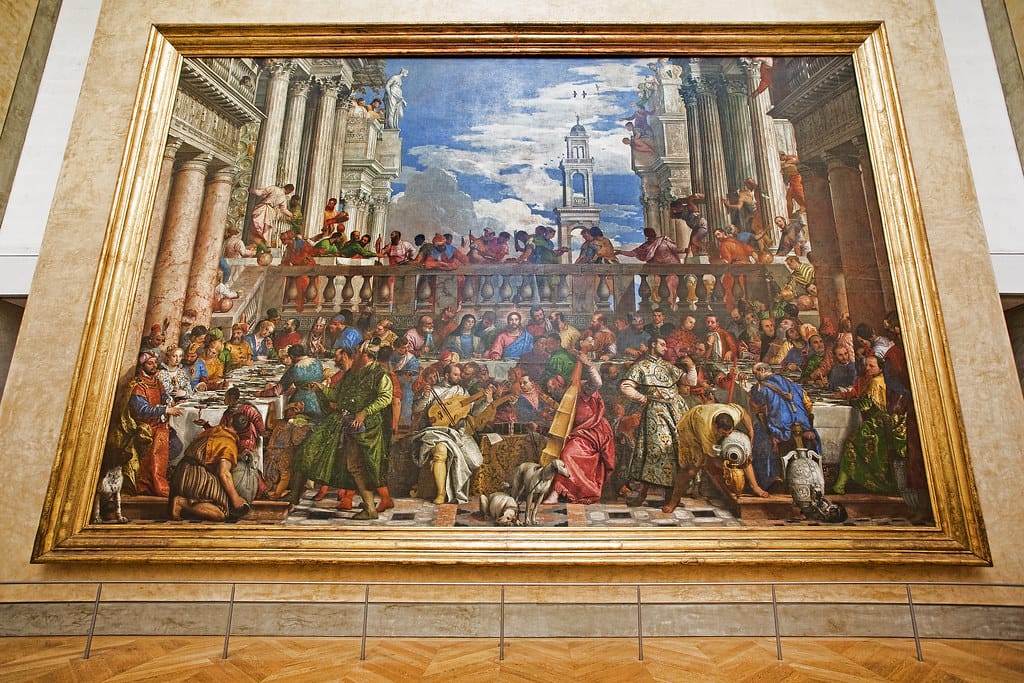
So why do we put value in certain things (like the Mona Lisa) and not others (like The Wedding at Cana)?
It’s about trust.
Without trust, these envy-based economies collapse.
It’s similar to the U.S. dollar.
When you look at our currency, it’s just a piece of paper. Physically, it is useless. Maybe if you needed a fire, it would help. But it’s about what it represents that makes it valuable. We all agree that I can trade this funny piece of paper with a picture of Benjamin Franklin (worthless) for food at the grocery store or clothes to keep me warm (vital to our survival).
The moment we lose trust in this system, the economy collapses.
Like Silver says in his book,
“CryptoPunks are desirable mostly because other people desire them.”
French historian René Girard calls this mimetic desire—our tendency to mirror others' desires.
It’s why so many ads use celebrity endorsements. When we see people we like promoting a product, we’re more likely to also want the same thing.
So the next time you see people fighting at Costco for Pokémon cards, or spending $6.2 million on a banana duct taped to a wall, remember that envy-based economies only work as long as people want them to.
“The wicked envy and hate; it is their way of admiring.”
Thanks for reading!
If you have any questions, hit me up on LinkedIn or on Twitter/𝕏 at @sam_starkman, or feel free to reply to this email!

— Sam